
Introduction
In addition to standard and enhanced resolution time-series data, SolarAnywhere® offers high resolution time-series and typical year (TGY/TDY) data for more accurate sub-hourly PV modeling. High-resolution data has the following key features:
- One- and five-minute typical year data, SolarAnywhere’s most advanced Typical GHI Year (TGY) and Typical DNI Year (TDY) offering. Designed to meet the growing need for precision in PV modeling, these datasets leverage AI-powered downscaling algorithms to deliver highly granular synthetic solar resource values with realistic intra-hour variability.
- Five-minute, 500-meter nominal native resolution time-series data using the maximum-available resolution of the latest generation of weather satellites for cloud detection to provide superior and reliable sub-hourly PV performance. The full resolution satellite data reveals the solar resource intermittency.
- True Dynamics (TD), a unique methodology for preparing satellite images for sub-hourly analysis and a feature of SolarAnywhere high-resolution time-series data. True Dynamics describes solar data that’s been augmented with statistical techniques to behave more like ground-based measurements of real sunlight. TD is applied to all high-resolution time-series (5-minute, 500-meter) data requests.
Applications of SolarAnywhere High-Resolution Data
Clipping Loss Assessment
Bright, sunny days are frequently broken up by intermittent clouds that move across a PV system at a sub-hourly timescale, causing short-term variability and possibly intermittent clipping.1 Using hourly data to predict power on bright, but cloudy, days can lead to over-predicted energy yield if the average irradiance during an hour results in generated power greater than the maximum inverter output rating. In 2012, researchers at Sandia found that hourly-averaged simulations overpredicted annual output by as much as 2%.5
More recently, the overprediction of AC energy due to clipping losses has been estimated at 1.5-4% annually depending on system design and location.6 Inverter saturation or clipping occurs when DC power from the PV array exceeds the maximum input rating of the inverter. In response, the inverter adjusts DC voltage to reduce the DC power. This results in lost DC power production, also known as ”inverter clipping.” Higher DC:AC ratios result in higher clipping losses. With the number of large utility-scale solar power plants increasing, higher DC:AC ratios are becoming more common, and some solar plants now even feature DC:AC ratios as high as 1.8.
Modeling PV production with high-resolution data instead of hourly resolution data can result in more site-specific and accurate clipping loss and PV production estimates.7 In internal testing, 5-minute simulations with SolarAnywhere True Dynamics data reduced clipping loss errors by more than 90% versus hourly data for high DC:AC scenarios (see Figure 1). Furthermore, when evaluating energy estimation error across a range of Inverter Loading Ratios (ILRs), DC:AC ratios, and climate zones, 1-minute TGY data consistently delivered more accurate results than hourly ground data (see Figure 2 and Figure 3).
In practice, users may also compare simulations with 1-minute and 5-minute against hourly data to estimate the clipping loss error adjustment that is appropriate for the hourly-averaged simulation.
Figure 1: Comparison of Estimated AC Clipping Losses Error
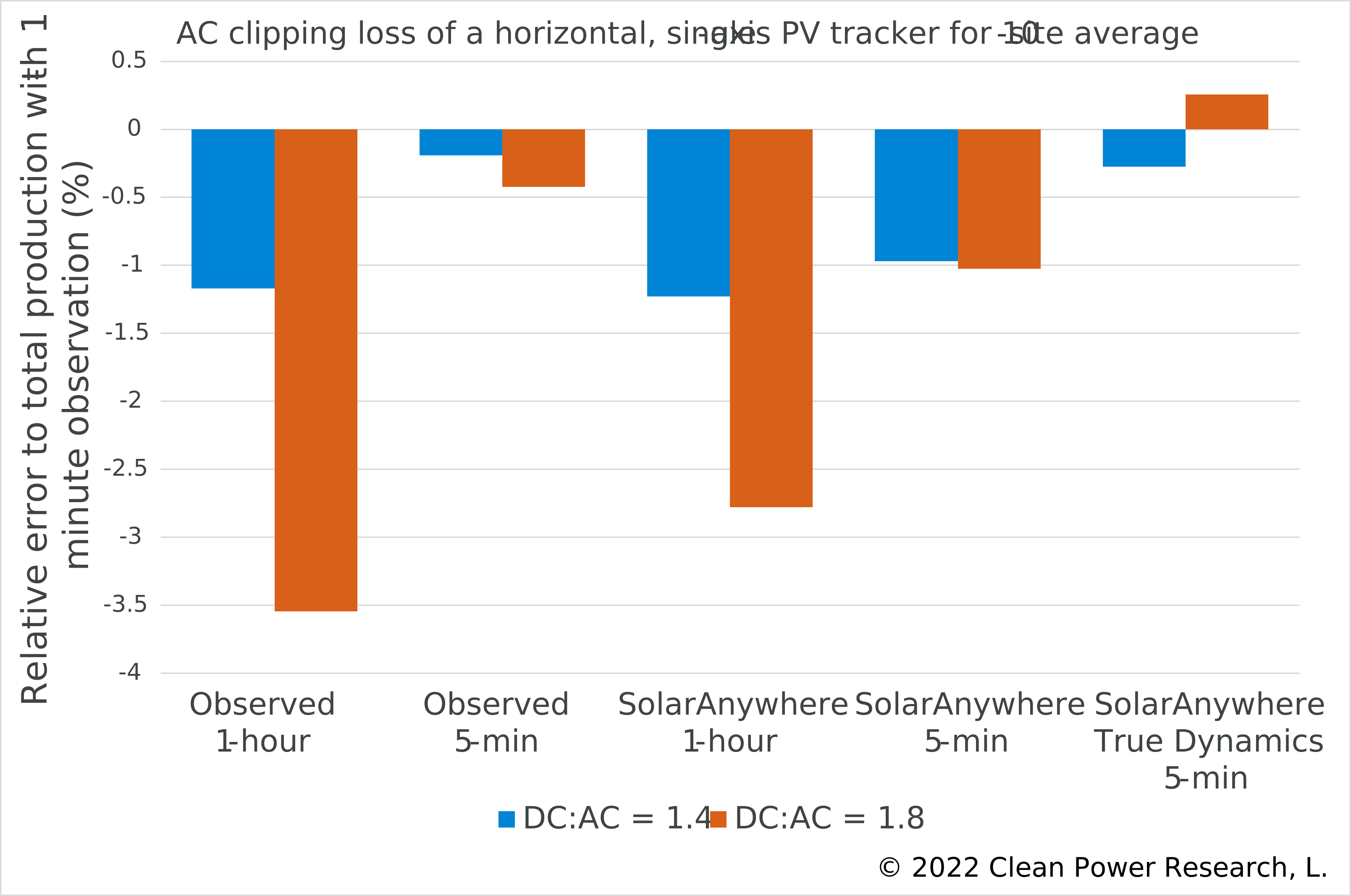
Estimated Losses Relative to 1-minute Observations for Hourly Averaged Observations, 5-minute Observations, SolarAnywhere Hourly, SolarAnywhere 5-minute, and SolarAnywhere 5-minute TD Data
Figure 2: Energy estimation error under certain Inverter Loading Ratios (ILRs)
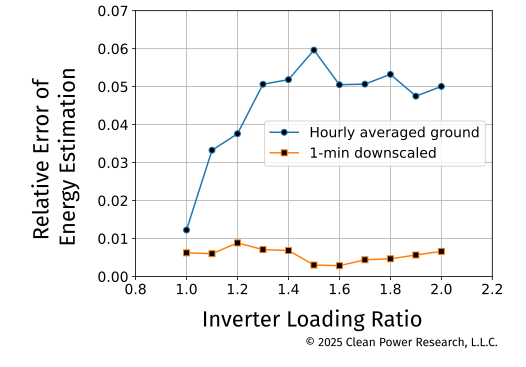
Relative error of energy estimation for hourly averaged ground data versus 1-minute downscaled data under varying Inverter Loading Ratios (ILRs) in Seattle during 2021.
Figure 3: Energy Estimation Error Across Climate Zones
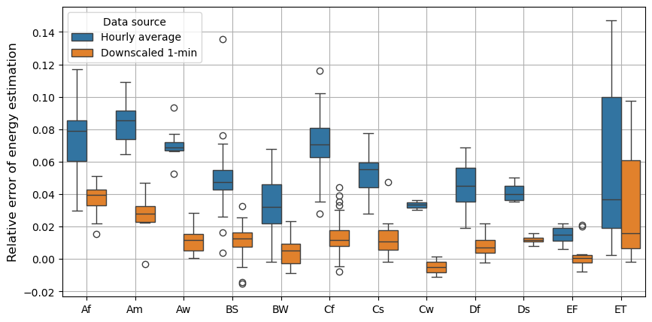
Relative error of energy estimation for hourly averaged ground data versus 1-minute downscaled data across multiple Köppen-Geiger climate classifications (ILR = 1.5). Box plots show that 1-minute modeled data consistently delivers lower error compared to hourly data, demonstrating improved accuracy for diverse climate conditions.
Designing Hybrid Solar Energy Resources
The high variability in solar resource due to moving clouds can cause fluctuations in PV power over sub-hourly timescales. As PV penetrations increase, this variability can lead to a negative impact on grid stability. To mitigate this, many grid codes incorporate ramp-rate (RR) limitations on the injected PV power. Generally, these limitations are defined by a second or minute time frame. For instance, Germany and Puerto Rico require a maximum ramp rate of 10% per minute of the rated PV power. Since the transient fluctuations in PV power can occur over minutes, hourly simulations are inadequate for modeling the sub-hourly ramps of solar power.
With a maturing solar market, off-takers are increasingly asking for clean, guaranteed power production regardless of the weather. Solar Power Purchase Agreements (PPAs) are shifting from unit contingent to firm solar power, wherein the solar plant owner may be required to incur the weather (or shape) risk. As a result, solar developers increasingly need to design systems that cost-effectively deliver firm power—regardless of the weather.
Hybrid solar-plus-storage power plants can help PV plants provide essential grid balancing services and meet ramping and smoothing requirements by reducing solar intermittency. Their growing popularity is evidenced by a report from the Berkeley Lab, which states that hybrid solar-plus-storage power plants now dominate interconnection queues in some regions in the U.S.8 Better sub-hourly PV modeling using SolarAnywhere high resolution data can help solar developers optimize PV project designs and attain tighter design margins, reducing the capital expenditure (CAPEX) needed to meet project requirements.
Together with hindcast data to evaluate battery dispatch and firming strategies, SolarAnywhere users can get the next-generation solar data needed to confidently model today’s hybrid solar energy resources.
High-resolution typical year data
High-resolution typical year data supports a range of valuable applications, including clipping loss analysis, battery dispatch modeling, due diligence, and energy yield assessment.
1- and 5-minute typical year data can be downloaded from the SolarAnywhere data website or requested via the API with access to a TypicalYear+ and/or Sites license. These datasets are available for all regions between +/-60° latitude.
Methodology
SolarAnywhere’s high-resolution 1- and 5-minute typical year (TGY/TDY) datasets are built to support sub-hourly PV modeling with maximum temporal precision. Generation begins with native satellite imagery, which is then downscaled to one- or five-minute resolution using an enhanced statistical AI model developed by Clean Power Research.
This model builds on prior research conducted by Clean Power Research and utilizes a T-Copula approach to ensure statistical consistency across hourly, monthly, and annual insolation totals. To accurately capture intra-hour variability, a synthetic variability adjustment—based on extensive ground datasets used to train the model—is applied. This adjustment mimics the short-term fluctuations observed in ground-based irradiance measurements, resulting in realistic solar resource profiles that are ideally suited for advanced modeling applications such as clipping loss analysis and battery dispatch simulation.
Data Validation
SolarAnywhere’s high-resolution typical year data was developed through rigorous research and validation. The bankability of the high-resolution TGY/TDY datasets is ensured through the following measures:
- Annual insolation preservation: Annual totals for Global Horizontal Irradiance (GHI), Direct Normal Irradiance (DNI), and Diffuse Horizontal Irradiance (DHI) in the 1-minute and 5-minute datasets are validated to retain annual consistency—within 0.1%, and more often within 0.01%—of the corresponding hourly values.
- Ground-matched variability patterns: The Kolmogorov–Smirnov Index (KSI) of GHI, ramp rates of GHI, and the ratio of variability index (RVI)—defined as the ratio of the standard deviation of 1-minute modeled GHI data to the standard deviation of 1-minute ground-measured GHI data—are evaluated to confirm realistic intra-hour variability.
- Global ground truth benchmarking: Validation is conducted at 1-minute resolution across a network of trusted ground stations, including only Class A pyranometric sites maintained to BSRN data quality standards.
- Robustness across climates: The validation framework spans diverse regions and climate zones, ensuring the model’s reliability for projects worldwide.
The figures below represent a single 24-hour period at the SURFRAD Bondville location in Illinois. They demonstrate that modeled 1-minute and 5-minute GHI data closely resemble ground measurements, effectively capturing short-term variability that is smoothed out in 15-, 30-, and 60-minute data. This is evident in time-series plots, where the 1-minute modeled data shows similar variability to ground data while the hourly model misses rapid fluctuations.
Figure 4: SolarAnywhere Modeled GHI and Ground Data Comparison at SURFRAD Bondville (12-Hour Period)
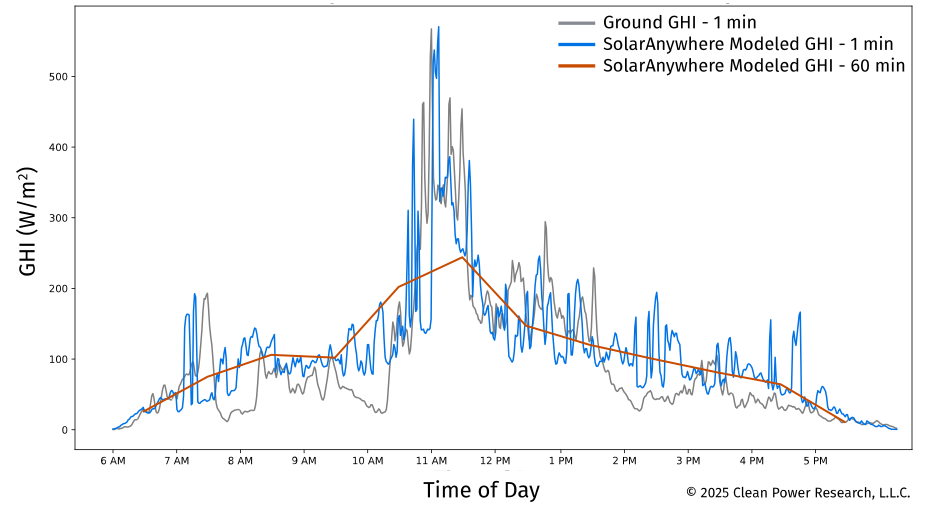
Time-series comparison of 1-minute ground-measured GHI versus SolarAnywhere modeled GHI at 1- and 60-minute resolutions. The 1-minute modeled data closely tracks ground observations relative to the 60-minute resolution.
Figure 5: SolarAnywhere Modeled GHI Comparison at SURFRAD Bondville (12-Hour Period)
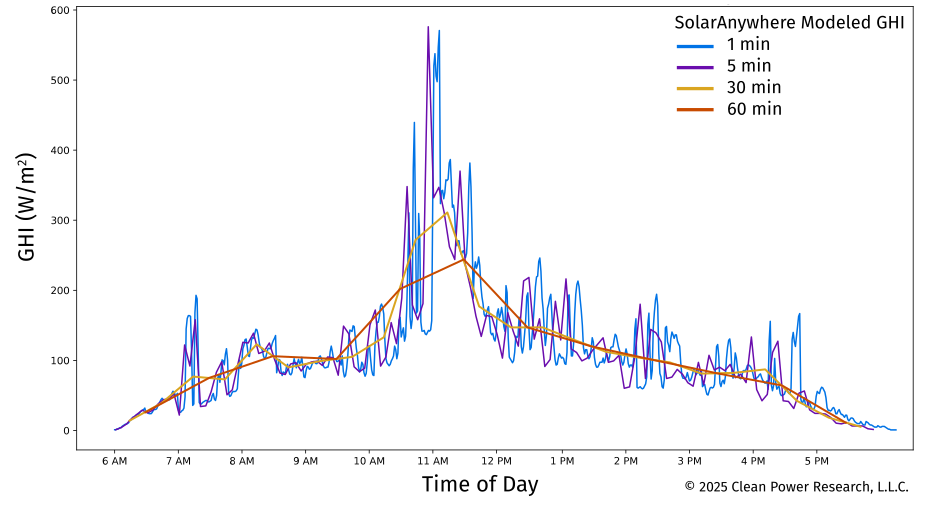
Time-series comparison of SolarAnywhere modeled GHI at multiple resolutions (1-minute, 5-minute, 30-minute and 60-minute). The 1-minute modeled data better captures short-term variability that is smoothed out in coarser intervals.
The probability density function (PDF) plots shown below for 1-minute global horizontal irradiance (GHI) and clear sky index (kt) provide a statistical comparison between ground measurements and SolarAnywhere modeled data. When the PDFs for ground and modeled data closely match, it demonstrates that the modeled data accurately reproduces the distribution of irradiance values and clear sky conditions observed in real-world measurements. For GHI, this means the frequency and magnitude of solar irradiance values in the modeled dataset are consistent with those recorded by ground sensors, capturing both typical and extreme conditions. Similarly, for the clear sky index (kt), a close match in PDFs indicates that the modeled data reliably reflects the variability and frequency of clear and cloudy conditions throughout the day. This strong agreement in the PDFs for both GHI and kt validates that SolarAnywhere’s high-resolution typical year data preserves the statistical characteristics of ground truth, supporting its use in advanced PV modeling, energy yield assessment, and risk analysis.
Figure 6: Probability Density Functions of GHI and Clear Sky Index (kt)
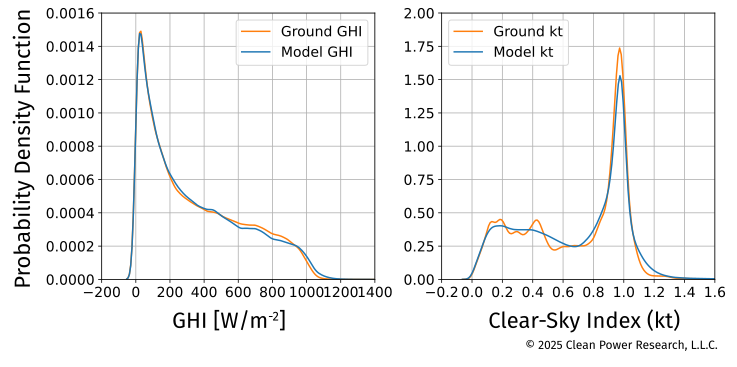
Probability density function plots comparing ground measurements and SolarAnywhere modeled data for 1-minute GHI and clear sky index (kt). The close alignment between distributions demonstrates that the modeled data accurately reproduces the statistical characteristics of irradiance and sky conditions observed in real-world measurements.
To confirm the reliability of SolarAnywhere’s high-resolution 1-minute and 5-minute Typical Year datasets, validation was performed across multiple years (2019–2024) and a broad network of SURFRAD and SOLRAD stations representing diverse geographic and climate regions. This approach ensures that accuracy is not limited to isolated examples but is consistent over time and across varying conditions.
Table 1: Validation Metrics for 1-Minute Modeled Data vs. Ground Measurements (2019–2024)
| Network | Station | KSI of GHI | Variability Ratio of GHI | KSI of DNI | Variability Ratio of DNI | Köppen-Geiger Climate Classification |
|---|---|---|---|---|---|---|
| SURFRAD | Surfrad - GoodwinCreek | 0.0341 | 0.9656 | 0.1355 | 0.9336 | Cf |
| SOLRAD | SolRad - Albuquerque | 0.0274 | 0.9767 | 0.0562 | 0.9679 | BS |
| SOLRAD | SolRad - Hanford | 0.0225 | 0.9811 | 0.0897 | 0.9818 | BS |
| SURFRAD | Surfrad - DesertRock | 0.0181 | 0.969 | 0.154 | 0.9199 | BW |
| SURFRAD | Surfrad - Bondville | 0.0284 | 0.9637 | 0.1536 | 0.9327 | Cf |
| SURFRAD | Surfrad - Boulder | 0.02 | 0.9888 | 0.1114 | 0.9199 | BS |
| SURFRAD | Surfrad - PennState | 0.0346 | 0.955 | 0.1972 | 0.9228 | Cf |
| SOLRAD | SolRad - SaltLake | 0.0297 | 0.9947 | 0.0937 | 0.9691 | BS |
| SOLRAD | SolRad - Madison | 0.0428 | 0.9787 | 0.1451 | 0.9345 | Df |
| SURFRAD | Surfrad - SiouxFalls | 0.0131 | 0.9779 | 0.139 | 0.9336 | Df |
| SOLRAD | SolRad - Bismarck | 0.0126 | 0.9834 | 0.1313 | 0.9367 | Df |
| SOLRAD | SolRad - Seattle | 0.0188 | 0.9913 | 0.156 | 0.9503 | Cs |
| SURFRAD | Surfrad - FortPeck | 0.0199 | 0.9884 | 0.1352 | 0.9332 | BS |
Summary of Variability Ratio and KSI values for GHI and DNI across SURFRAD and BSRN stations, demonstrating strong agreement between modeled and ground data.
The table above summarizes results for 1-minute data only, comparing SolarAnywhere modeled GHI and DNI against ground observations across multiple stations and climates. Two key metrics were used:
- Variability Ratio (σ(∆GHI₁min))
Compares the standard deviation of 1-minute GHI ramp rates between ground measurements and modeled data. A ratio of 1.0 indicates a perfect match, meaning the modeled data mirrors short-term fluctuations observed in ground measurements. Ratios close to 1 confirm that synthetic variability introduced by the model closely mimics real-world conditions.
- Kolmogorov–Smirnov Index (KSI(|∆GHI₁min|))
Measures the similarity between distributions of absolute 1-minute GHI ramp rates in ground and modeled data. Lower KSI values indicate stronger agreement (0 means a perfect match), validating that the model preserves the statistical behavior of irradiance variability.
These metrics were computed for both GHI and DNI across all validation sites. Results show strong agreement between SolarAnywhere modeled data and ground truth, confirming that the model accurately reproduces intra-hour variability across diverse climates and geographies.
This site-level validation demonstrates that SolarAnywhere’s high-resolution TGY/TDY datasets are statistically consistent and suitable for advanced PV modeling applications, including clipping loss analysis, battery dispatch simulation, and energy yield assessment.
For more details on why high-resolution typical year data matters for accurate energy production estimation, see our recently published blog.
High-resolution time-series data
Applications of high-resolution time-series data include estimation of ramp rates, firming requirements, clipping losses and more.
Historical, high-resolution time-series data with True Dynamics can be downloaded from the SolarAnywhere data website or requested via the API with a High-resolution Sites license. Within the SolarAnywhere data website, existing Sites can be upgraded to high resolution on demand. High-resolution time-series data is currently available for locations in the continental United States (CONUS) region from January 1, 2020 to the historical data cutoff, updated monthly.
Methodology
SolarAnywhere high-resolution time-series data takes maximum advantage of the latest generation of GOES satellites (GOES-East and GOES-West) operated by the National Oceanic and Atmospheric Administration (NOAA). The satellites scan the continental United States at a spatio-temporal resolution of 500-meters, 5-minute, which is 24 times the resolution (6X temporal, 4X spatial) of previous generations. The full resolution GOES data input reveals the solar resource intermittency.
To get the most accurate clipping loss and ramp rate simulations, solar data must have realistic sub-hourly variabilities and power distributions. True Dynamics was developed in partnership with Dr. Richard Perez and his team at the University at Albany’s Atmospheric Sciences Research Center and stands on the shoulders of decades of solar variability research.1
A key insight from their research is that the variability of solar data can be related to both the spatial and temporal averaging of the solar data. A point will have more variability than an area. In many cases, the relevant area for modeling is the footprint of the panels connected to a utility-scale inverter.2 (Solar plants with DC coupled storage may take advantage of increased spatial smoothing).3
Certain cloudy conditions can increase the amount of sunlight reaching solar PV systems owing to refraction from frozen water molecules in high-altitude clouds. Clear-sky exceedance events occur when irradiance exceeds clear-sky irradiance values due to nearby clouds, also termed as cloud enhancement. Empirical data shows that cloud enhancement is common in variable conditions and happens too fast to be represented in hourly models. To capture clear-sky exceedance events, True Dynamics synthetically enhances the variability observed in the high-resolution, 5-minute, 500-meter data.
Finally, decomposition models designed for hourly data must be adjusted for high-resolution input data.
As demonstrated in Figure 7, the 5-min TD data captures large, intra-hourly ramp rates and clear-sky exceedance events due to cloud reflection that are not evident in hourly-averaged data. Consequently, using the 5-min TD data generally leads to a more accurate estimation of AC energy.
Figure 7: Time-series Simulation Using SolarAnywhere Hourly and 5-minute TD, and 1-minute Observed Data
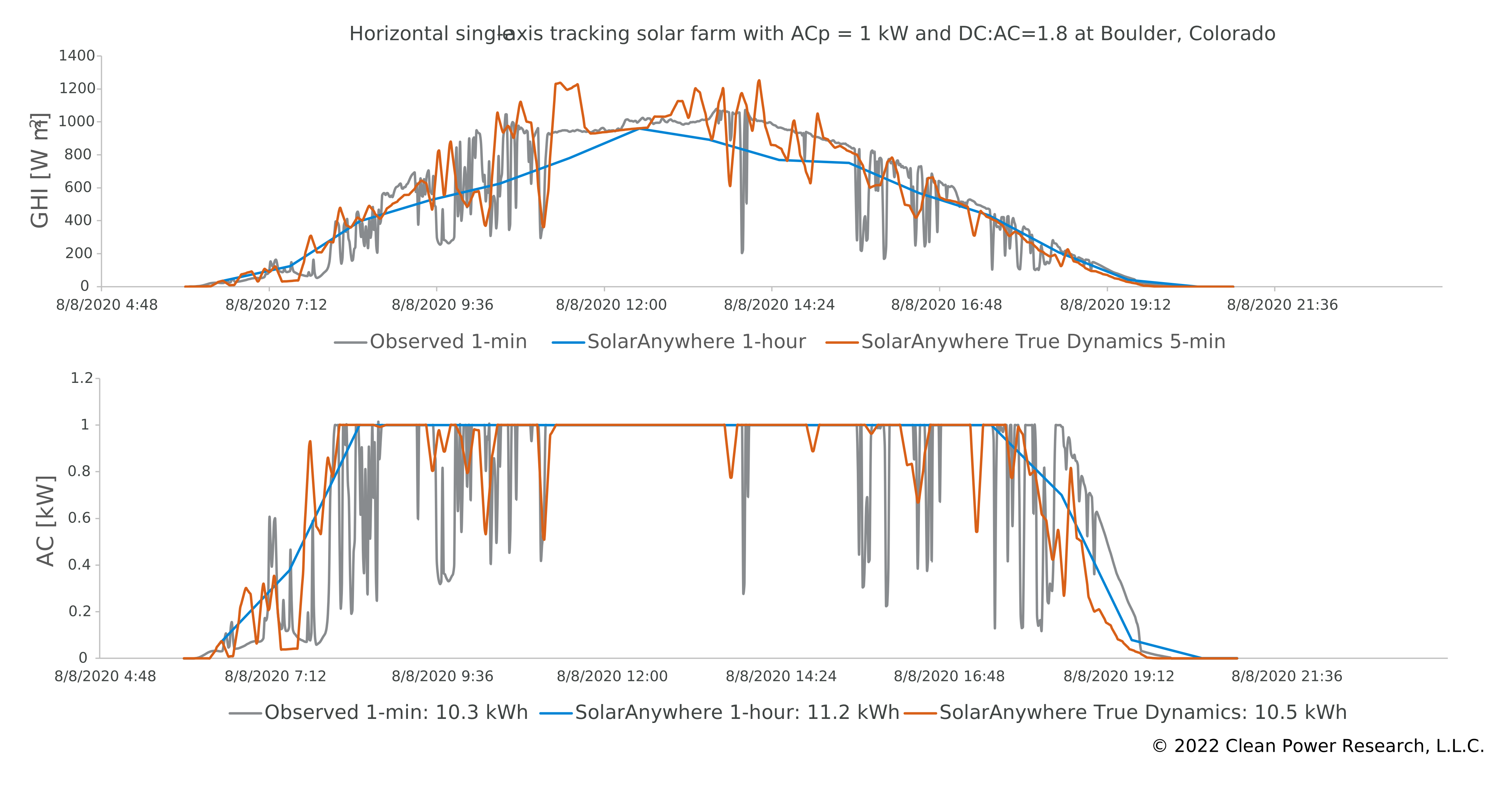
The top graph is a comparison of GHI time series at Boulder on August 8, 2020, between SolarAnywhere hourly and 5-minute TD, and 1-minute Observed Data. The bottom graph shows the corresponding simulated AC power production using a prevailing configuration: horizontal single-axis tracking PV with power inverter nameplate capacity of 1kW. The total energy calculated for that day using the three data sources are also shown in the graph.
You can learn more about the TD methodology and results in the paper: “Enhancing temporal variability of 5-minute satellite-derived solar irradiance data.”4
References
1 Perez R, David M, Hoff T, Jamaly M, Kivalov S, Kleissl J, Lauret P, Perez M, 2016. Spatial and Temporal Variability of Solar Energy. Foundations and Trends® in Renewable Energy, Volume 1, Number 1: 1-44. doi.org/10.1561/2700000006. Link
2 Hobbs W, 2020. Overestimating output in hourly models due to high DC:AC ratios and solar variability: an introduction. ESIG System Planning Working Group, Summer Session. Link
3 Ahlstrom M, Mays J, Gimon E, Gelston A, Murphy C, Denholm P, Nemet G, 2021. Hybrid Resources: Challenges, Implications, Opportunities, and Innovation. IEEE Power and Energy Magazine, Volume 19, Issue 6: 37-44. DOI: 10.1109/MPE.2021.3104077. Link
4Huang J, Perez R, Schlemmer J, Kubiniec A, Perez M, Bhat A, Keelin P, 2022. Enhancing temporal variability of 5-minute satellite-derived solar irradiance data. IEEE Photovoltaic Specialists Conference (PVSC). Link
5 Hansen C W, Stein J S, Riley D, 2012. Effect of Time Scale on Analysis of PV System Performance. Sandia National Laboratories, Report number: SAND2012-1099. DOI:10.13140/2.1.1150.3368. Link
6 Bradford K, Walker R, Moon D, Ibanez M, 2020. A Regression Model to Correct for Intra-Hourly Irradiance Variability Bias in Solar Energy Models. 2020 47th IEEE Photovoltaic Specialists Conference (PVSC), June 15-August 21, 2021. DOI: 10.1109/PVSC45281.2020.9300613. Link
7 Cormode D, Croft N, Hamilton R, Kottmer S, 2019. “A method for error compensation of modeled annual energy production estimates introduced by intra-hour irradiance variability at PV power plants with a high DC to AC ratio. 2019 IEEE 46th Photovoltaic Specialists Conference (PVSC): 2293–2298. DOI: 10.1109/PVSC40753.2019.8981206. Link
8 Seel J, Warner C, Mills A D, October 2021. Influence of Business Models on PV-Battery Dispatch Decisions and Market Value. Advances in Applied Energy. DOI: 10.1016/j.adapen.2021.100076. Link