
This page contains a complete list of the irradiance data fields available from SolarAnywhere®. SolarAnywhere generates irradiance data using proprietary models.
Global Horizontal Irradiance (GHI)
Global horizontal irradiance is the total solar radiation per unit area measured at a horizontal surface on the earth. It is typically presented in W/m2 and can be broken down into two components: direct normal irradiance (DNI) and diffuse horizontal irradiance (DHI). The relationship between GHI, DHI and DNI is expressed in the equation below:
GHI=DHI+DNI*cos (α_{zenith} )
Units: W/m2
Direct Normal Irradiance (DNI)
Direct normal irradiance (DNI) is the portion of solar radiation that reaches the earth on a direct path from the sun.
Units: W/m2

Diffuse Horizontal Irradiance (DIF or DHI)
Diffuse horizontal irradiance (DIF or DHI) is the portion of solar radiation that reaches the earth indirectly. Water vapor, aerosols and clouds reflect and absorb solar radiation, diffusing it throughout the atmosphere.
When modeling solar energy systems, the diffuse irradiance may be assumed to be isotropic, meaning that the scattered component of solar irradiance is evenly distributed as it reaches a surface. This assumption simplifies PV modeling calculations by treating the diffuse irradiance as uniform and isotropic, enabling more efficient assessment of PV system performance
Units: W/m2
Clear-Sky Irradiance
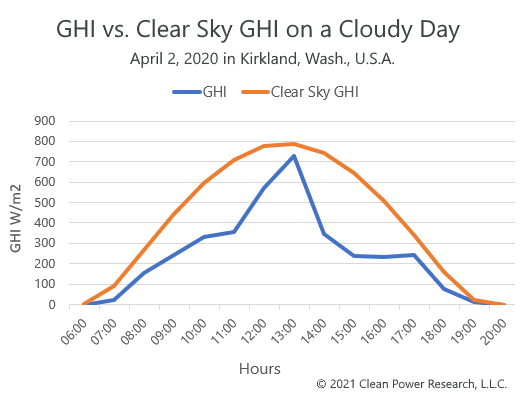
Irradiance calculated prior to taking cloud cover into consideration. Clear-sky irradiance is calculated based on solar geometry, elevation, water vapor, ozone, albedo, and aerosol optical depth. Aerosol optical depth is a quantification of the aerosols, such as dust, haze, ash, sea salt, etc., distributed between the surface of the earth and the top of the atmosphere. Recent SolarAnywhere versions utilize publicly available aerosol optical depth data from the Merra-2 reanalysis. Visit release notes to see the AOD input changes accompanying SolarAnywhere version releases. The validation for this AOD source is available here.
Clear-sky irradiance data is helpful when using solar resource data to analyze PV system performance. It helps in differentiating between cloudy conditions and other circumstances that may be affecting plant performance, such as equipment failure or losses due to snow cover or soiling.
Units: W/m2
Irradiance Observation Type
The irradiance observation type refers to a two-character code used to indicate two things:
- The model (historical, real-time or forecast) used in generating the irradiance value
- Whether the value was observed, missing, estimated or filled with a long-term average
Visit Missing Data to learn more.
The first character indicates the model used to generate the irradiance value or if the user is not licensed for a portion of the requested date range:
| F | Forecast | The forecast model was used to generate the irradiance values. |
| M | Month | The real-time model was used to generate the irradiance values. “Month” is short for “current month” in reference to a portion of the period for which the real-time model is used. |
| A | Archive | The historical model was used to generate the irradiance value. Data generated using the historical model is archived, meaning data downloaded for a certain location will never change in future downloads at that location (if requesting within the same data version). |
| U | Unlicensed | The user requesting the data is not licensed for these irradiance observations. |
The second character indicates whether the value was observed, missing, estimated, or filled with a long-term average:
| D | Day | Observed daytime irradiance values. |
| N | Night | Nighttime observation time, irradiance values will equal 0. |
| M | Missing | Visit Missing Data for more information. |
| F | Filled | Irradiance values filled with a long-term average irradiance value. Visit Missing Data for more information. |
| E | Estimated | Irradiance values generated from surrounding values when data is missing for short periods (less than 4 consecutive hours). |
| S | Short range estimate | Forecast values for short range up to 7 days ahead based on a blend of NWP models. |
| L | Long range estimate | Forecast values beyond 7 days ahead. |
| 1 | 1-Minute estimate | Advanced forecast values, generally from 1-minute up to 5-hours ahead based on the satellite cloud motion vector approach. |
Examples:
| AD | A daytime irradiance value generated using the historical model. |
| MD | A daytime irradiance value generated using the real time model. |
| AF | A daytime irradiance value during a historical data period of missing satellite data, filled with long term averages. |
Solar Zenith Angle
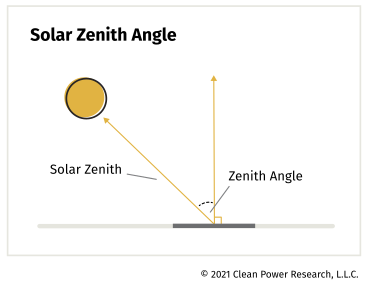
The zenith angle (αzenith) is used in determining the position of the sun in relation to a specific location on earth. It’s used to calculate the amount of irradiance reaching that location at a given time of day. It is the angle between a line that is normal to a horizontal surface on the earth and a line drawn directly to the sun from the horizontal surface.
Plane of Array Irradiance
Plane of Array Irradiance (POAI) refers to the solar irradiance reaching the plane of the PV module. POAI is calculated using a transposition model that considers the PV module array azimuth and tilt or tracking to calculate the irradiance reaching the module surface. SolarAnywhere energy models use the Perez transposition model, which also considers the effects of row-to-row shading.